Ten of Swords Tarot Card Meaning

The Ten of Swords marks an ending that can no longer be protected by reinterpretation. The present form is over or severely compromised, and the first useful work is to stop adding injury and secure the aftermath.

The Ten of Swords is finality after a mental or relational pattern has exhausted every extension. Its value is not drama; it is the clarity that allows containment, mourning, and a different beginning.

  • painful ending
  • finality
  • collapse
  • exhausted pattern
  • aftermath
  • dawn
Ten of Swords tarot card from a Rider-Waite-Smith-style deck
Ten of Swords · Swords suit Artwork by Pamela Colman Smith (1909) · Public Domain Mark 1.0
Number
10
Upright
No
Reversed
Maybe

Ten of Swords upright and reversed meaning

Direct expression

Upright

The Ten of Swords marks an ending that can no longer be protected by reinterpretation. The present form is over or severely compromised, and the first useful work is to stop adding injury and secure the aftermath.

Tens show consequence at the end of a suit cycle. Swords reaches the point where another argument, explanation, or patch cannot restore the previous structure. Accepting that limit prevents the mind from using complexity to postpone necessary closure.

The card requires proportionate language. It can symbolize defeat, burnout, exposure, or a painful conclusion, but it is not literal proof of physical harm. Describe the known event, assess immediate needs, and involve appropriate services if real safety, health, or legal concerns exist.

Practical adviceTreat the ending as real, contain further damage, and make the first decision from the conditions that remain rather than the plan that failed.
Blocked or redirected

Reversed

Reversed, the worst phase may be passing, recovery may be starting, or the ending may be prolonged because the same failed form is repeatedly revived.

Reversal can turn attention toward the horizon. Recovery begins through ordinary acts: sleep, documentation, medical care, legal closure, a revised plan, or contact with people unaffected by the collapsed system. The new phase may be modest before it feels hopeful.

A prolonged ending occurs when the person repeatedly reopens negotiation with a condition that has already supplied its answer. Set a final boundary, archive the record, and invest in the next viable structure rather than another version of the same rescue.

Practical adviceUse the dawn to begin recovery, not to pretend the completed ending never occurred.

Symbols in Ten of Swords

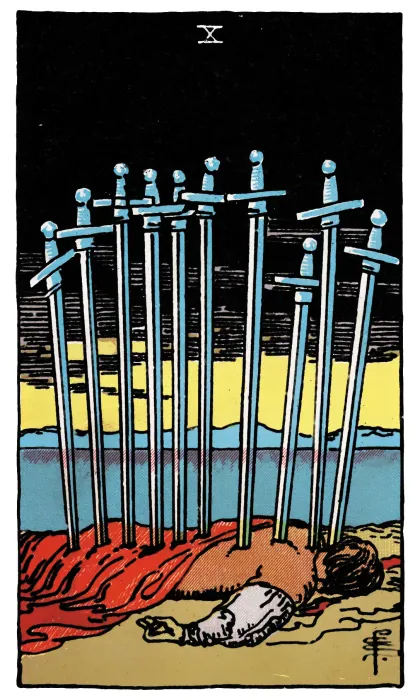
In the Rider-Waite-Smith image, a figure lies face down with ten swords placed along the back. A red cloth covers the lower body, and one hand rests near the ground in a deliberate gesture. The upper sky is black with heavy clouds, while a golden band of dawn appears above calm water and distant dark hills. The contrast is absolute: the foreground cannot continue, but light is already present beyond it.

Ten swords in the fallen figure
The completed number and overwhelming placement make finality and exhausted continuation unmistakable.
The red cloth
A vivid covering keeps life, injury, dignity, and consequence concentrated in the foreground.
The black sky
Heavy darkness represents the closed condition at its most severe point.
Golden dawn over calm water
Light beyond the hills introduces a future that does not erase the finality of the foreground.

Love, career, money, feelings, and yes-or-no meanings

Love & relationships

Love · upright

A relationship, argument pattern, or expectation may have reached a definitive breaking point. The image is dramatic, but it should not be used to predict violence, death, or inevitable betrayal. Protect safety, accept the stated ending, and direct energy toward support and practical next steps.

Reversed

A person may begin to rebuild after separation or finally stop replaying the final injury. Reconciliation is not the default meaning. If the relationship is being reconsidered, require evidence that the structure causing the collapse has changed.

Try a three-card love tarot reading

Work & direction

Career · upright

A project, role, business assumption, or professional relationship may fail decisively. Stop concealing the scale of the problem and preserve records, people, and assets that remain. A clear closure plan prevents denial from turning one failure into several.

Reversed

Recovery, restructuring, or a controlled restart may follow a failure. The reversal can also show a project kept alive through sunk-cost pressure. Define which assets and lessons transfer forward, and close the rest rather than renaming the same model.

Draw one card for practical guidance

Emotional perspective

As feelings · upright

the Ten of Swords suggests devastation, exhaustion, or certainty that the current form cannot continue. Someone may have no capacity for further discussion. Their boundary should be taken literally rather than treated as a dramatic test.

Reversed

They may be less acute, beginning to release, or still vulnerable to being pulled back into the final conflict. A person can heal without wanting renewed contact. Respect the direction of their current action.

Resources & exchange

Money · upright

The card can indicate a failed venture, insolvency risk, job loss, or a plan that has reached its limit. Stop further exposure, gather statements and contracts, and seek qualified financial or legal advice where consequences are substantial.

Reversed

Reversed, restructuring, settlement, new income, or closure may begin to stabilize the position. The shadow is extending a failed investment to avoid recognizing the loss. Fund recovery and essentials before any attempt to restore the old image.

Directional shorthand

Yes or No Direction

UprightNo

No; the current form has reached an ending or level of damage that makes continuation under the same assumptions irresponsible.

ReversedMaybe

Yes to recovery or a genuinely restructured beginning, but no to reviving the same failed arrangement without material change.

“How do I begin again after a complete setback?”

Interpretation

Define what ended and what did not. Protect surviving resources, conduct a factual review, and make the first recovery action small enough to complete.

Ten of Swords in a past, present, future spread

01

Past

A decisive ending or betrayal still shapes present expectations.

02

Present

The failed pattern needs to be recognized as finished.

03

Future

Recovery begins when the ending is accepted and the lesson is separated from shame.

Want to see these positions with cards of your own? Try a Past–Present–Future tarot reading.