Five of Swords Tarot Card Meaning

The Five of Swords asks what a victory costs when trust, dignity, or future cooperation is damaged in the process. Winning the immediate contest may leave the larger objective weaker.

The Five of Swords is conflict assessed after the decisive moment. It moves attention from who won to what the method damaged and whether any future relationship remains worth rebuilding.

  • conflict
  • hollow victory
  • self-interest
  • aftermath
  • humiliation
  • cost of winning
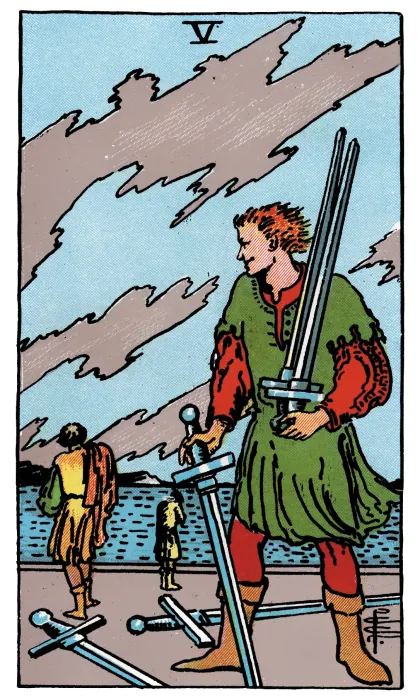
Five of Swords tarot card from a Rider-Waite-Smith-style deck
Five of Swords · Swords suit Artwork by Pamela Colman Smith (1909) · Public Domain Mark 1.0
Number
5
Upright
No
Reversed
Maybe

Five of Swords upright and reversed meaning

Direct expression

Upright

The Five of Swords asks what a victory costs when trust, dignity, or future cooperation is damaged in the process. Winning the immediate contest may leave the larger objective weaker.

Fives disrupt prior balance. In Swords, the disruption comes through strategy, language, and power used without a workable shared rule. The immediate question may be won while the conditions for future trust disappear.

The card does not require passive surrender. Defense, documentation, and firm boundaries may be necessary. Its warning concerns method: whether the response preserves proportionality and the ability to live with the result after adrenaline and audience attention have gone.

Practical adviceDecide whether the prize is worth the relationship and downstream cost before taking the final advantage.
Blocked or redirected

Reversed

Reversed, conflict may move toward apology and repair, or remain active beneath a surface ceasefire. Regret is useful only when it changes behavior and the distribution of power.

Reversal can open the possibility of de-escalation. A real apology identifies the conduct, impact, and change without demanding immediate forgiveness. Repair also restores agency to the person harmed, including the right not to continue the relationship.

A conflict can look over because the less powerful party stopped responding. Silence under pressure is not resolution. Check whether terms changed, records were corrected, or safety improved before labeling the situation repaired.

Practical adviceRepair what can be repaired through accountability, and leave the contest where continued engagement would only repeat harm.

Symbols in Five of Swords

In the Rider-Waite-Smith image, a foreground figure gathers swords and looks back with a slight smile. Two swords lie on the ground while he holds three. Farther away, two people turn toward the water; one appears to cover the face in distress. Jagged gray clouds stretch across the sky, and the shoreline recedes behind the group. The winner occupies the largest space, but the departing figures and abandoned weapons make the social cost equally visible.

The figure holding three swords
The apparent winner controls most of the weapons and the foreground after the contest.
Two abandoned swords
Weapons left on the ground show surrender, withdrawal, and the cost of continuing.
The departing figures
Distance and visible distress shift attention from victory to relational aftermath.
Jagged clouds over water
The unsettled sky and shoreline sustain tension after the active clash has ended.

Love, career, money, feelings, and yes-or-no meanings

Love & relationships

Love · upright

An argument can become a campaign to punish, expose, or force surrender. Even a factually correct person can handle the conflict destructively. Stop the exchange when contempt or intimidation appears, protect safety, and return only if both people can discuss the issue without making humiliation the goal.

Reversed

Someone may want to end a harmful argument pattern, admit wrongdoing, or recover after separation. Reconciliation is not owed because the aggressor feels regret. Look for accountability, respect for boundaries, and a specific plan for handling the next disagreement.

Try a three-card love tarot reading

Work & direction

Career · upright

Office politics, hostile negotiation, credit-taking, or a win-at-all-costs culture may reward behavior that harms the team. Document what happened and protect your position, but do not imitate the tactic without considering reputation and future dependencies. Some contests are best exited.

Reversed

A political conflict may be settling, or an unfair outcome may still require formal response. Choose the channel that can produce remedy rather than another private confrontation. A strategic withdrawal can preserve energy without declaring the conduct acceptable.

Draw one card for practical guidance

Emotional perspective

As feelings · upright

the Five of Swords can show resentment, defensiveness, shame, or a desire to regain power after feeling exposed. Someone may care and still choose a harmful tactic. Emotion explains behavior but does not excuse humiliation or coercion.

Reversed

They may include regret, exhaustion with conflict, or a cautious wish to make amends. A person can feel sorry primarily because they dislike the consequence. Changed conduct over time distinguishes accountability from discomfort.

Resources & exchange

Money · upright

The card can flag adversarial negotiation, unfair fees, disputed assets, or a deal where one side benefits by hiding the full cost. Preserve documents and assess enforcement options. A cheap victory may create larger legal, reputational, or operational expense.

Reversed

Reversed, settlement, repayment, or withdrawal from a costly dispute may become possible. Do not accept terms solely to end emotional strain if they create material harm. For significant matters, use independent legal or financial advice.

Directional shorthand

Yes or No Direction

UprightNo

Usually no when success depends on humiliation, hidden advantage, or a conflict method that destroys the relationship needed afterward.

ReversedMaybe

Maybe after genuine accountability or a fair settlement changes the conditions; a quiet battlefield alone is not evidence of repair.

“Is it worth continuing this argument?”

Interpretation

Continue only if a concrete boundary or decision can still be achieved without humiliation. If the contest is now about dominance, end the exchange and protect the relationship or your exit.

Five of Swords in a past, present, future spread

01

Past

A win-at-all-costs conflict damaged trust.

02

Present

The immediate tactic is threatening the larger objective.

03

Future

De-escalation or separation may be needed before a useful outcome is possible.

Want to see these positions with cards of your own? Try a Past–Present–Future tarot reading.