Five of Wands Tarot Card Meaning

The Five of Wands brings several active wills into the same space without a shared method. The friction may be useful practice or wasteful conflict; the difference lies in rules, stakes, and what the participants learn.

The Five of Wands is uncoordinated energy made visible. It asks whether competition is sharpening skill and information or merely consuming the attention needed to complete the work.

  • competition
  • friction
  • practice
  • conflicting aims
  • debate
  • coordination
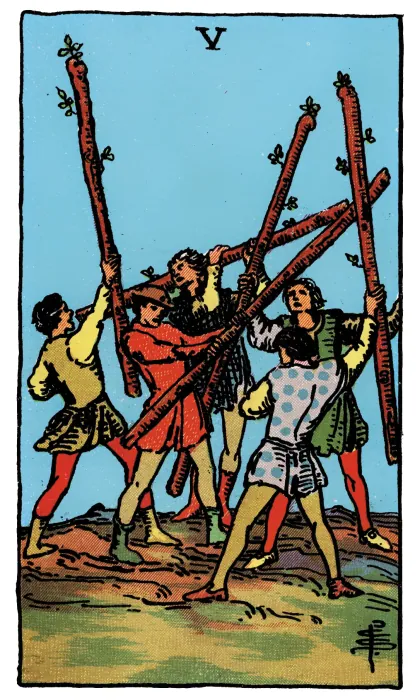
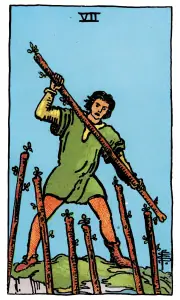
Five of Wands tarot card from a Rider-Waite-Smith-style deck
Five of Wands · Wands suit Artwork by Pamela Colman Smith (1909) · Public Domain Mark 1.0
Number
5
Upright
No
Reversed
Maybe

Five of Wands upright and reversed meaning

Direct expression

Upright

The Five of Wands brings several active wills into the same space without a shared method. The friction may be useful practice or wasteful conflict; the difference lies in rules, stakes, and what the participants learn.

Fives interrupt stability. In Wands, the interruption comes through competing effort rather than a lack of energy. Multiple people may be trying to help, lead, impress, or protect their position at once. The first repair is often procedural: define the problem and decide how competing proposals will be compared.

Not every conflict should be removed. Practice matches, editorial challenge, negotiation, and honest disagreement reveal weak assumptions before the stakes increase. The card favors friction that has consent, boundaries, and a way to convert what is learned into better performance.

Practical adviceDefine the rules, the decision owner, and the point at which discussion must produce a coordinated action.
Blocked or redirected

Reversed

Reversed, conflict is suppressed, avoided, or allowed to continue after it has stopped producing insight. Surface agreement may conceal resentment, while exhaustion can make even useful disagreement feel intolerable.

Reversed, people may agree too quickly because disagreement feels unsafe. The cost appears later as passive resistance, rework, or private conversations that should have happened in the room. A smaller, facilitated discussion can surface the contested issue without turning it into a general attack.

The reversal can also show conflict fatigue. Even when an issue matters, the participants may lack the capacity for another open-ended debate. Narrow the agenda, state the decision deadline, and postpone questions that do not affect the current choice.

Practical adviceAddress the real disagreement once, with limits, rather than reenacting it through dozens of smaller frictions.

Symbols in Five of Wands

In the Rider-Waite-Smith image, five young figures hold long wooden staffs that cross at different angles above and between them. Their clothing is brightly colored and varied, and each body faces a different direction. No clear injury, referee, or common target appears. The open ground and blue sky make the scene easy to observe but ambiguous: it can be read as practice, play, a chaotic exercise, or a genuine struggle without organized rules.

Five crossing staffs
The overlapping wands show effort obstructing effort because no common formation has been established.
Five differently dressed figures
Varied clothing emphasizes separate identities, interests, and methods sharing one contested space.
No visible referee or target
The image withholds a clear rule or objective, making coordination the central interpretive problem.
Open ground and clear sky
Nothing external traps the group; the disorder arises from how the participants are relating to one another.

Love, career, money, feelings, and yes-or-no meanings

Love & relationships

Love · upright

A relationship can be lively but exhausting when every preference becomes a contest. Teasing, debate, competing schedules, or outside demands may create heat without a true threat to the bond. Agree on what is negotiable and stop using minor victories as evidence of who cares more.

Reversed

One or both people may avoid a necessary argument until irritation leaks into unrelated moments. The reversal can also mark the end of a quarrelsome phase. Distinguish genuine resolution from silence purchased by one person abandoning their needs.

Try a three-card love tarot reading

Work & direction

Career · upright

At work, overlapping ownership, peer competition, or a room full of ideas may generate noise. This can improve a proposal when the contest is bounded and the decision rule is known. Without those conditions, capable people spend energy defending territory instead of combining information.

Reversed

A team may be conflict-averse, politically fragmented, or tired of repeated debate with no decision. Alternatively, roles are finally being clarified. Use written responsibilities and a specific escalation path so the same disagreement does not have to be rediscovered in every meeting.

Draw one card for practical guidance

Emotional perspective

As feelings · upright

the Five of Wands can show attraction mixed with rivalry, defensiveness, or a desire to be noticed. Someone may enjoy the chase yet struggle with cooperation once attention is secured. Watch whether playful friction can stop when a boundary or serious need is expressed.

Reversed

They may involve suppressed irritation, fear of confrontation, or relief that a competitive pattern is ending. A person could appear agreeable while privately keeping score. Direct, low-stakes conversation is more reliable than interpreting politeness as peace.

Resources & exchange

Money · upright

The card can point to competitive bidding, disputed priorities, or several expenses fighting for one budget. Competition may improve terms if criteria are clear. Avoid emotional auctions and decide in advance which cost, quality, and timing factors carry the most weight.

Reversed

Reversed, financial conflict may be hidden inside a household or partnership, or a price contest may no longer be worth pursuing. Put the actual numbers and decision rights in view. Walking away can be rational when winning would consume the margin.

Directional shorthand

Yes or No Direction

UprightNo

Maybe; the opportunity can develop, but competing aims and unclear rules must be organized before the answer becomes dependable.

ReversedMaybe

Not while necessary disagreement is being avoided or the participants are too depleted to resolve the same recurring conflict.

“Is the tension in this group productive or a sign I should leave?”

Interpretation

Look for a shared goal and fair rules. If disagreement improves the work, structure it; if people are defending status rather than the outcome, reduce exposure.

Five of Wands in a past, present, future spread

01

Past

Earlier competition or unresolved disagreement created the current strain.

02

Present

Several priorities are colliding and need a common rule.

03

Future

Friction can produce clarity if the conflict is contained and purposeful.

Want to see these positions with cards of your own? Try a Past–Present–Future tarot reading.